

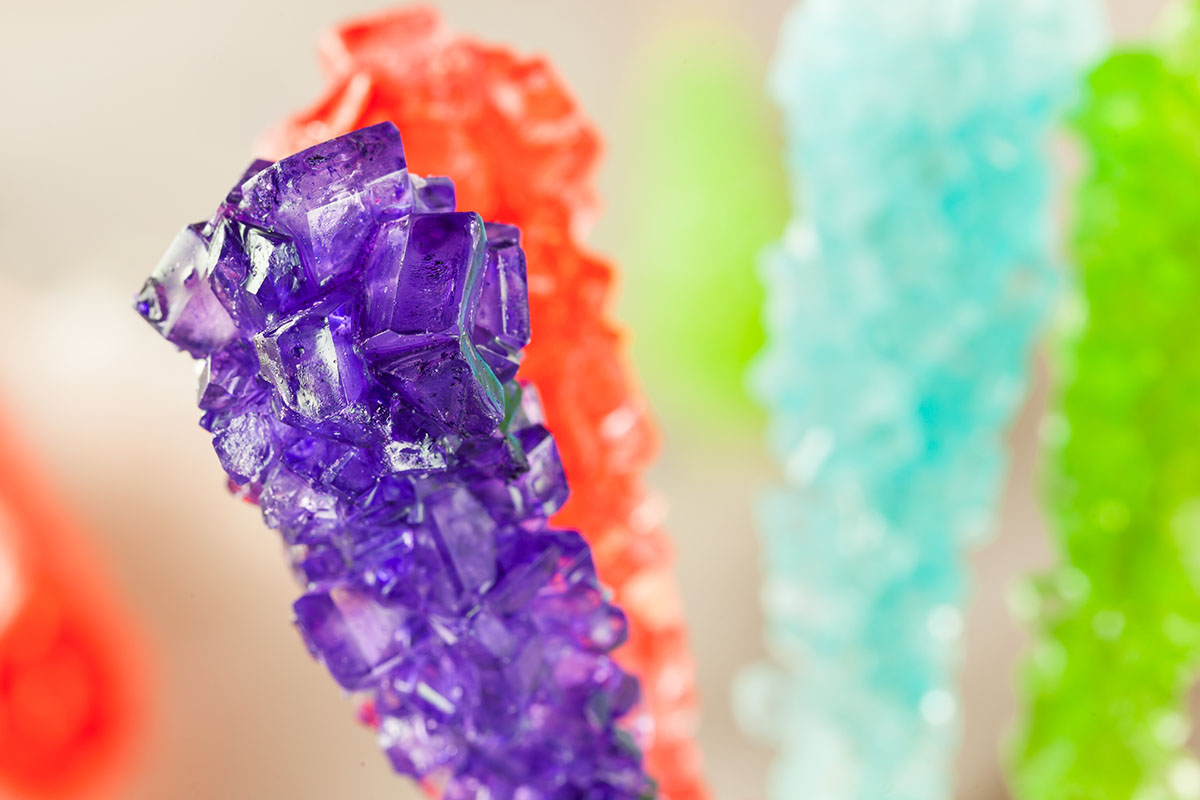
What if we told you that you could grow sparkling crystals—and then eat them? With a little patience and a lot of sugar, you can! Rock candy is more than just a sweet treat—it’s a hands-on science experiment that shows how crystals form. Get ready to mix, stir, and watch as colorful crystals grow right in your kitchen.
What You’ll Need
Before you begin, gather these supplies:
- 2–3 cups of sugar
- 1 cup of water
- A saucepan
- Wooden spoon
- Heat-safe glass jar or cup
- Wooden skewer or string
- Clothespin or tape
- Food coloring (optional)
- Flavor extract (optional, like peppermint or vanilla)
Step-by-Step Instructions
- Prepare the Stick: Dip your wooden skewer in water, then roll it in sugar. Let it dry completely. This gives crystals a “head start” by providing a rough surface for them to cling to.
- Make the Sugar Solution: In a saucepan, bring 1 cup of water to a boil. Slowly add sugar, one spoonful at a time, stirring constantly until it dissolves. Keep adding sugar until no more will dissolve—this creates a supersaturated solution. (It usually takes about 2–3 cups of sugar.)
- Add Extras: If you want colorful or flavored rock candy, stir in a few drops of food coloring and a splash of extract now.
- Pour into Jar: Carefully pour the hot sugar solution into your glass jar.
- Insert the Stick: Place your sugared skewer into the jar, making sure it hangs in the middle without touching the sides or bottom. Use a clothespin balanced on top of the jar to hold it in place.
- Wait for the Magic: Place your jar somewhere it won’t be disturbed. Over the next 5–7 days, crystals will begin to form and grow along the skewer.
The Science Behind the Crystals
So, how do plain sugar and water turn into crunchy crystals? It’s all about supersaturation and crystallization:
- Supersaturation: Normally, water can only hold a certain amount of sugar. But by heating the water, you can dissolve much more than usual. Once the solution cools, it’s “supersaturated,” meaning it has more sugar than it can really hold.
- Crystallization: As the water slowly evaporates, sugar molecules start to separate out and cling to the skewer. They lock together in repeating patterns, forming crystals.
- Seed Crystals: The sugar coating you added to the skewer gives the new crystals a place to start growing. Without it, crystals might still form—but it would take longer.
Fun Variations to Try
Want to make your rock candy even cooler? Try these twists:
- Rainbow Candy: Make several jars with different food coloring, then display your crystal sticks like a rainbow.
- Double Layer: Grow crystals on a string in one color, then move it into another jar with a different color to create layered candy.
- Crystal Race: Set up multiple jars and compare how fast crystals grow in warm spots versus cool spots.
- Shape Challenge: Use string instead of a skewer, and tie it into fun shapes (like a star or heart). Watch crystals form all over the design!
Real-Life Connections
Crystal growing isn’t just for candy—it happens all around us:
- Salt & Sugar: Table salt and sugar are everyday examples of natural crystals.
- Snowflakes: Each snowflake is a crystal of frozen water, with unique patterns formed as it falls through the atmosphere.
- Gems & Minerals: Crystals like quartz, diamonds, and amethyst are formed deep in the Earth over thousands of years.
- Science Labs: Scientists study crystallization to make medicines, grow semiconductors for electronics, and even create new materials.
What You’re Learning
The Rock Candy experiment teaches you a lot about science while giving you a sweet snack:
- Chemistry: How heating water lets it hold more sugar than normal.
- Supersaturation: Why solutions can hold extra material when hot, then release it as crystals when cooling.
- Patience & Observation: Crystals grow slowly—sometimes the best science takes time.
- Patterns in Nature: From sugar crystals to snowflakes, molecules form predictable shapes when they crystallize.
Safety Notes
- Always ask an adult for help when using the stove.
- The sugar solution is very hot at first—be careful when pouring.
- Don’t try to rush the process. Crystals take time, but the results are worth it!
Wrap-Up
Growing rock candy crystals is like running your own candy factory and science lab at the same time. With just sugar, water, and patience, you’ll watch dazzling crystals appear right in front of you. Not only will you learn how molecules form patterns, but you’ll also get to enjoy a sweet reward at the end.
So grab some sugar, set up your jars, and let science (and candy) grow day by day. Sometimes the tastiest experiments are also the most educational!